


Gavekort kampagne

 Indkøbsvogn
Sum: 0,00 € (0)

Gavekort kampagne
Kampagneperiode indtil: 2026-03-02
Tjenesten telefon
+49 6443-81284-28
man - Fredag: 9:00 - 16:30 kl
Sa: 8:00 - 18:00 kl
Værdibeviser


Mercedes #23 3. Targa Florio 1924 Neubauer, Hemminger 1:18 CMC


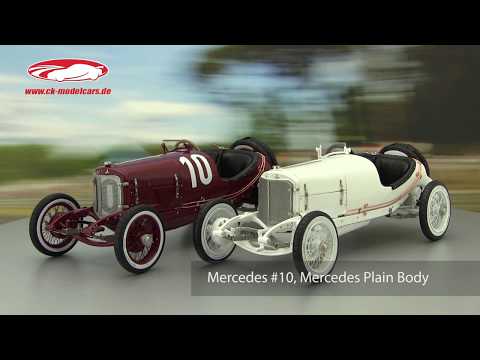
infoCMC
1:18
Daimler-Motoren-Gesellschaft (DMG)
Alfred Neubauer, Ernst Hemminger
Mercedes
1924
3. Targa Florio 1924
600 pcs.
M-186
Modellen er fremstillet i den kendte høje CMC-kvalitet og genspejler originalen på bedst mulig vis.
modelsærheder:
- cockpitmodel tro mod originalen
- detaljeret motorrum
- High-End kvalitet og detaljer
- forhjul med styring
- Limited Edition
- kølerhjelm kan åbnes
A masterpiece of architecture model:
Model details:
- Precision metal model hand-assembled of more than 1.009 single parts
- Steering wheel with metal spokes
- Steering wheel rim covered with leather, leather seats
- Nicely designed dash board with round instruments
- Movable drivers wind shield
- Movable lever for ignition- and compound adjustment
- Manual pump to set the gas tank under pressure and grease gun for water pump lubrication
- Double-leaf enginehood made of copper. Side panel can also be opened
- Highly detailed engine with cabeling and arangement of levers
- Removable spark plug sockets
- Motor-subshell of copper sheet
- Steel wire-brake cables for the front and rear wheels
- Rotating metal-starter hand crank
- Cooler with rock protection guard from fine-meshed wire netting
- Shock absorber with movable lever arm
- Moving handbrake with working detent pawl and upholstered leather handle
- The starting number 23 is mounted in an elaborate tampon printing method on the burgundy painted body
- Six-layer metal leaf springs with spring function at the front and rear axle
- Tank filler neck and tank cap with removable bayonet lock stainless steel
- Functional hood locks with spiral springs
Description of the original vehicle:
In 1923, the great era of supercharged racing cars began. The Daimler factory in Stuttgart-Untertürkheim did not sit idle on this trend, and the development of a new supercharged vehicle soon got under way.
It was the preparation of a race car for the 1924 Targa Florio, and Ferdinand Porsche had become the new chief designer at Daimler-Motoren-Gesellschaft. Under his personal direction, a team of engineers took an in-depth look into the 1923 M7294 compressor engine and came up with some ground-breaking upgrades. As a result, the mximum output was pushed up to 126 hp (even to 150 hp in late 1924). This was made possible by relocating the compressor - Roots blower – to the front of the engine. When power was required, the driver could now activate it by a forceful step on the gas pedal. It would trigger mechanic action or movement to bring the output from a normal 68 hp up to 126 hp.
The Targa Florio and the Coppa Florio were two of the toughest and most difficult road races in Europe. Running on the extremely narrow and winding mountain roads of the so-called Madonie Circuit near Palermo on Sicily, one lap lasted 108 km long. Four laps were to drive for the Targa Florio, totaling 432 km. For the Coppa Florio, another lap was added, extending the race to a total of 540 km. In either race, entrants had to deal with a grueling circuit full of the dangers known as "7000 curves". Whoever won the Targa Florio was not necessarily going to win the Coppa Florio, because the odds to negotiate the last lap successfully were not always very good.
Mercedes would dispatch three vehicles to this prestigious race event, and preparations were made well in advance. Two T-cars were sent to Sicily for test drives three months earlier. Various rear axle ratios were tried out, and an optimal maximum speed of 120 km/h was found for the racing locally.
0visitors look at
this product
at this moment
this product
at this moment
0customers have
recently ordered
this product
recently ordered
this product
Følgende produkter svarer bedst til søgningen:
